There’s a particular kind of exhaustion that has nothing to do with how much you did that day. You can come home, sit down, and still feel tense, like your brain never quite gets permission to shut off. Often, it isn’t your schedule causing that feeling. It’s your space.
Clutter isn’t just about mess or poor organization. It’s deeply psychological. The things we keep, stack, store, and avoid dealing with are tied to memory, identity, fear, guilt, and the pressure of modern life. That’s why clutter can feel so emotionally heavy, and why “just getting rid of stuff” rarely works on its own.
Understanding the psychology of clutter is the missing piece for many people. Once you see why you hold on, letting go becomes less about discipline and more about relief.
Why Clutter Affects the Brain More Than We Realize
Clutter doesn’t have to be extreme to have an impact. Even a fairly normal, lived-in mess can quietly tax the nervous system. Our brains are constantly scanning our environment for information. When every surface holds objects, your brain is forced to process more visual input than it can comfortably manage. That excess stimulation keeps the mind in a low-level state of alertness, even when you’re trying to relax.
Over time, clutter can:
- Increase stress hormones like cortisol
- Make it harder to focus or think clearly
- Reduce working memory and decision-making capacity
- Create a sense of constant background pressure
This is why clutter often feels mentally “loud,” even when the house is silent.
The Emotional Reasons We Hold On to Things
Sentimental Attachment and Memory

Some belongings act as emotional containers. Baby clothes, handwritten notes, old journals, souvenirs, or inherited items can feel like physical proof that a moment, a relationship, or a version of ourselves existed. Letting go of these items can feel like erasing part of that story, even when we know, logically, that memories don’t live in objects. The emotional brain doesn’t operate on logic alone.
Identity and “Future Me” Clutter
Many homes contain items meant for a future version of the owner. Exercise equipment for a routine that never started. Art supplies for a hobby that didn’t take root. Clothes for a lifestyle that no longer fits. These items aren’t neutral. They quietly represent expectations, hopes, or pressure to become someone else. Holding onto them can feel easier than acknowledging that a season has passed.
Guilt, Money, and Regret
Items we spent money on but didn’t use often carry emotional weight. So do things we bought during stressful periods or life transitions. Keeping them can feel like avoiding the discomfort of admitting, That didn’t work out, and that’s okay. Fear of regret also plays a role. Most people have experienced getting rid of something and wishing they hadn’t. That single experience can reinforce a habit of keeping far more than necessary “just in case.”
Decision Fatigue and Why Clutter Builds So Easily
Every item sitting in your home carries an unresolved decision. Keep it or let it go. Store it, donate it, repair it, replace it. Those choices may seem small on their own, but together they create a steady cognitive load.
When your days are already filled with constant decision-making, such as work responsibilities, family needs, schedules, finances, your brain looks for ways to conserve energy. Putting decisions off can feel like relief, not failure. That’s why avoidance isn’t a character flaw; it’s a nervous system trying to protect itself from overload.
Clutter grows in the spaces where decisions get delayed. Not because people don’t care about their homes, but because caring takes focus, emotional bandwidth, and energy that many people are simply running low on by the end of the day.
Cultural Pressure and the Normalization of “Too Much”

Modern consumer culture quietly encourages accumulation. Sales cycles, social media, and advertising reinforce the idea that being prepared, successful, or happy means having more. At the same time, very few people are taught how to let go without guilt. There’s little guidance on how to release items responsibly, emotionally, and confidently. The result is homes filled with objects that feel obligatory rather than useful. Clutter thrives at the intersection of acquisition and hesitation.
How Clutter Shapes Daily Life (Often Without You Noticing)
Clutter not only exists in the background but also subtly reshapes how you experience your entire day. When a space is filled with unfinished decisions, the effects ripple into everyday routines in ways that often go unnoticed at first.
You may find that:
- Cleaning takes longer than it should because you’re constantly working around piles and obstacles
- Mornings feel rushed and disorganized as you search for items instead of moving smoothly through your routine
- Relaxation feels incomplete or fragile, easily interrupted by visual reminders of what still needs attention
- Small tasks feel far more draining than expected, even when they require little physical effort
- Mental energy is spent managing what’s “out of place” rather than enjoying the moment
- Motivation drops as the space begins to feel overwhelming instead of manageable
The longer clutter remains, the harder it feels to start addressing it. That cycle feeds on itself, reinforcing the idea that the mess is permanent.
Why Letting Go Feels Risky, but Is Often Transformative
Letting go can trigger unexpected emotions: sadness, fear, anxiety, or even grief. That reaction doesn’t mean you’re doing something wrong. It means the item held meaning.
What often surprises people is what happens after letting go. As clutter decreases, many experience:
- Reduced mental noise
- A greater sense of calm and focus
- More patience and emotional bandwidth
- A feeling of control returning
Your home stops feeling like another responsibility to manage and starts functioning as a supportive environment. Psychologically, this shift matters. A calmer space sends your nervous system a powerful signal: you’re safe to rest here.
Releasing Items Without Losing the Meaning
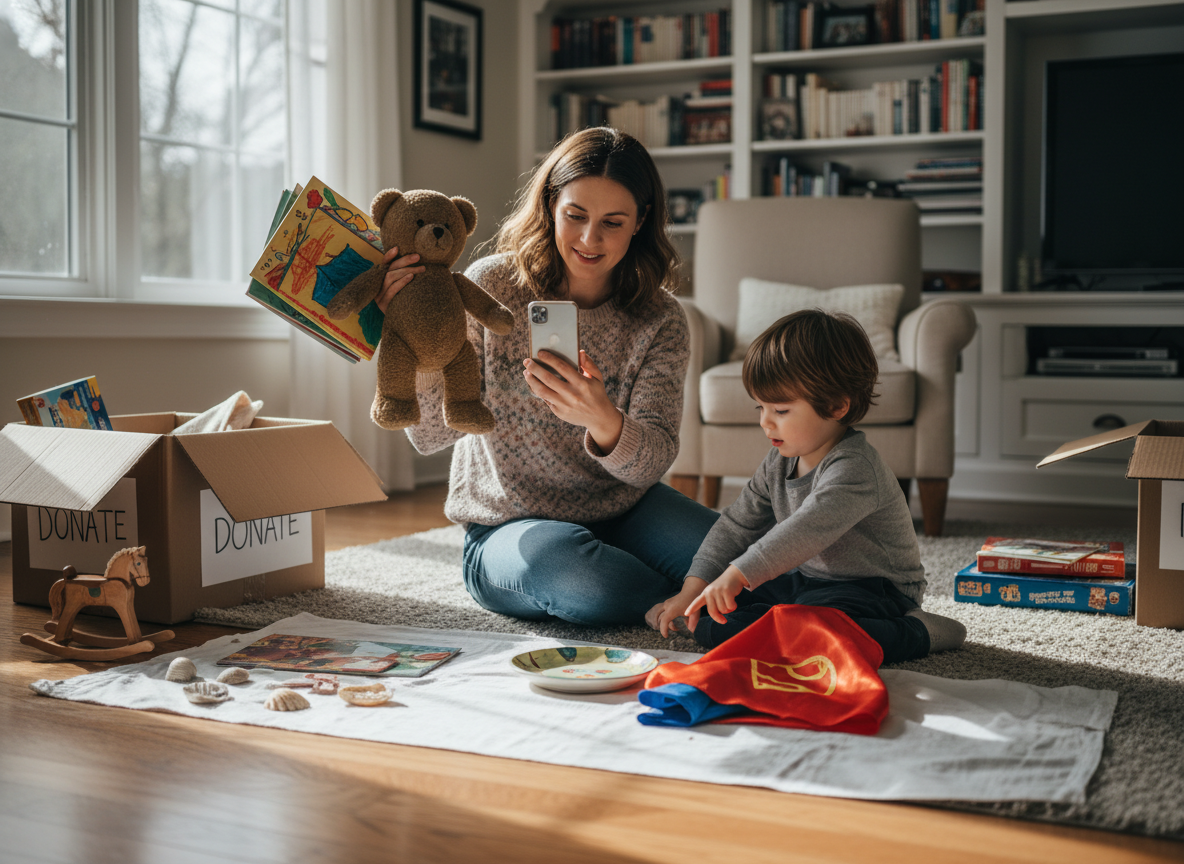
One strategy that helps many people release emotionally charged items is learning to separate the memory from the object itself. Taking photos of sentimental belongings before letting them go preserves the story without requiring the item to stay physically present in your home.
The memory remains. The meaning remains. Your identity remains, but the space opens.
This approach works especially well for items tied to children, past careers, or major life chapters. It allows you to honor what those items represented without asking your home to permanently store every stage of your life. Over time, this shift can ease the fear that letting go means forgetting, and replace it with a quieter confidence that your experiences live within you, not within your storage spaces.
Why Confidence Grows as You Declutter
Decluttering is a skill, not a personality trait, and like any skill, it strengthens with use. The more often you make small, low-pressure decisions, the less intimidating those choices feel over time. You don’t need to get it “right” every time; confidence grows through repetition. Each item you release quietly reinforces trust in your own judgment. With practice, the emotional intensity around letting go begins to fade. What once felt heavy or risky starts to feel clear and manageable, and hesitation is gradually replaced by a steadier sense of clarity and self-assurance.
A Kinder Perspective on Clutter
Clutter is a psychological response to stress, shifting identity, life transitions, and the pace of modern life. Beating yourself up only adds another layer of pressure, which tends to deepen avoidance rather than resolve it. When you look at clutter through a compassionate lens, the entire process changes. Replacing judgment with curiosity: “Why did this stay here? What did it represent?” makes the work feel lighter and far more sustainable. Understanding without shame is what creates real movement forward.
A Home That Supports the Life You’re Living Now
A calmer, more organized home is created by understanding why things accumulate and giving yourself permission to release what no longer fits your present life. Letting go is about making room: for clarity, for ease, for rest, and for the version of life you’re actually living now. And that shift, more than any storage solution, is what truly changes a home.
Related Articles
- Practical Ways to Break the Cycle of Procrastination in Home Organization and Build Consistent Decluttering Habits
- 10 Essential Benefits of an Organized Home: Why Home Organization Matters for a More Efficient, Stress-Free Lifestyle
- 12 Daily Habits and Key Characteristics of Highly Organized People for a More Efficient, Clutter-Free Lifestyle