


Do you pay security deposit before signing a lease? No, and holding to that rule is one of the simplest ways to protect your money. A security deposit exists because of the lease: the lease sets the amount, spells out what the deposit covers, and defines when you get it back. Pay before a signed lease exists and you are handing money to a promise rather than a binding contract.
What renters usually run into before signing is a holding deposit, a separate payment with its own rules, and the gap between the two is where rental scams live. This guide untangles those terms, walks the normal order of payment, and points out the red flags to watch for.
Note: this is general information, not legal advice, and the specifics vary by state.
Do You Pay Security Deposit Before Signing a Lease?
No, you should never pay a full security deposit without a written, signed lease in hand. In a normal rental, the deposit is paid at lease signing or shortly after, but not before, and landlords usually release the keys once your funds clear. The sequence matters because the deposit only means something once a signed lease stands behind it. Until both you and the landlord have signed, nothing governs that money or obligates anyone to return it.
Treat this timeline as non-negotiable. A legitimate landlord has no reason to need your deposit before the paperwork is done, and the ones who insist on early payment are usually the ones worth walking away from. If money has to move earlier to reserve a unit, that payment is a holding deposit, and it needs its own written terms, which the sections below cover.
The Normal Payment Process (Step by Step)
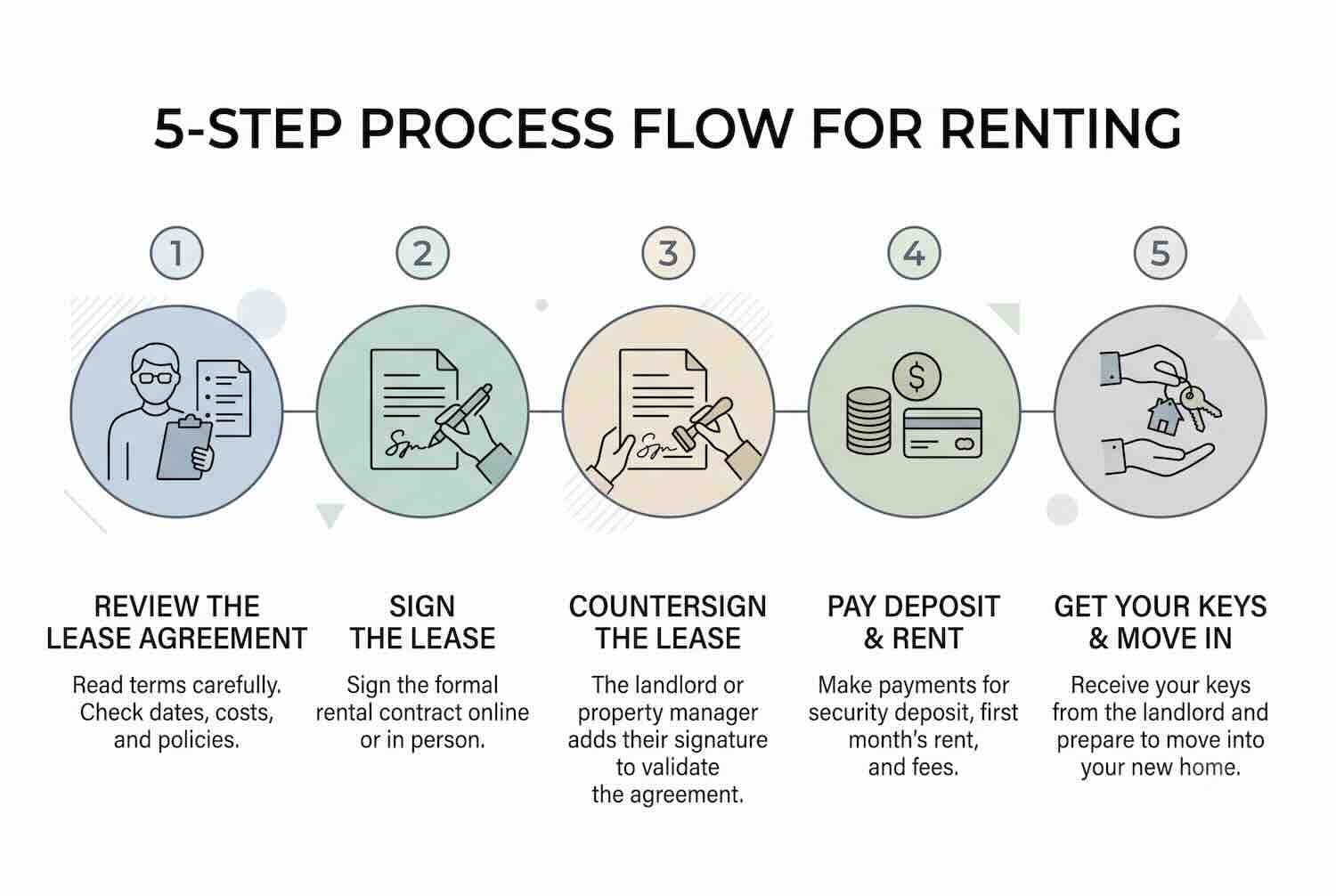
A straightforward rental moves cleanly from application to keys. Here is the order money actually changes hands.
- Review the lease in full. Read the whole document, paying attention to the deposit amount, the return terms, and any fees. Ask about anything unclear before you sign, not after.
- Sign the lease. Your signature commits you to the contract, so make sure the written terms match what you agreed to verbally.
- The landlord countersigns. The lease is not active until both parties have signed. Get a fully executed copy back for your records.
- Pay the deposit and first month’s rent. This is the point where money changes hands, usually the deposit plus the first month together.
- The lease goes active and keys are released. Most landlords hand over the keys once the funds clear.
For the payment itself, use a method you can trace: a cashier’s check, a money order, or an ACH transfer through a rental platform all leave a record. Avoid wiring money or sending it by Zelle or a similar app to someone you have not met, since those transfers are fast and hard to claw back if something goes wrong.
Holding Deposit vs Security Deposit vs First Month’s Rent
Three different payments get blurred together, and that blur is where people lose money. Sorting them out answers most of the question on its own.
| Payment | What it’s for | When paid | Refundable? | Governed by |
| Holding deposit | Reserves the unit while paperwork is finished | Before signing | Sometimes, often credited toward rent | A written holding agreement |
| Security deposit | Covers damage beyond normal wear and tear | At signing | Yes, minus lawful deductions | State law and the lease |
| First month’s rent | Pays for your first month of tenancy | At signing | No, it is rent, not a deposit | The lease |
The takeaway is that only a holding deposit changes hands before signing, and even that should come with clear written terms. If someone calls a pre-signing payment a “security deposit,” the label is wrong, and that mismatch is your cue to slow down and ask questions.
When a Landlord Asks for Money Before You Sign
Not every request for money before signing is a scam, but every one deserves a written agreement. A holding deposit can be a normal part of a competitive market, where a landlord takes a unit off the listing while your application clears. The problem is never the payment itself; it is paying without terms. This is really the heart of whether you pay a security deposit before signing a lease at all: anything that moves early should be a defined holding deposit, not a deposit in disguise.
Before you send a holding deposit, get four things in writing: the exact amount, what it holds and for how long, whether it applies to your rent once you sign, and what happens to it if either side backs out. A landlord who will put those four lines in an email or a short agreement is likely acting in good faith. One who wants cash now and promises to “sort out the details later” is the version to avoid.
Red Flags and Rental Scams to Watch For

Some requests are not just unusual; they are the fingerprints of a scam. Any one of these is a reason to pause, and two or more is a reason to walk.
- A demand to pay by wire, Zelle, Venmo, gift card, or crypto to someone you have never met
- No in-person or live video tour offered before money is expected
- An address you cannot verify on the county assessor’s site, or one listed elsewhere for sale
- Pressure to pay right now “to secure it” ahead of other applicants
- No written lease, or a lease that only appears after you have already paid
Scammers rely on urgency and untraceable payments, so removing either one usually ends the scheme. Slow the pace down, insist on a verifiable address and a real tour, and pay only through a method that leaves a paper trail.
Can You Negotiate or Waive a Security Deposit?
You can sometimes negotiate a deposit down, but it helps to keep expectations realistic. Most listings, especially those run through property-management companies, require the full deposit as a fixed condition, and independent landlords rarely waive it outright. Pushing to erase the deposit entirely is usually the least productive angle.
You often have better luck negotiating around it. Ask about lowering the rent, splitting move-in fees, or spreading the deposit over the first couple of months. Some renters also qualify for alternatives to a cash deposit, such as providing a guarantor, buying a surety bond, or using deposit insurance where the landlord accepts it.
>>> See more: How to Remove Peel and Stick Wallpaper Cleanly
What If You Already Sent Money and Something Is Wrong?
If the money is already gone and the deal has started to smell wrong, move quickly, because recovery odds drop with time.
- Send a written demand. Ask for the return in writing with a firm deadline, so you have a record of the request.
- Dispute the charge. If you paid by credit or debit card, contact the issuer about a chargeback; a bank may help with certain transfers.
- File a complaint. Report it to your state attorney general’s office or consumer protection agency, which tracks rental fraud.
- Consider small claims court. For amounts within the limit, small claims is a low-cost way to pursue the money without a lawyer.
None of these guarantees you get every dollar back, which is why the safeguards earlier in this guide matter more than any remedy after the fact.
Getting Your Deposit Back (Quick Overview)
Getting the deposit back is a move-out issue, but the process starts the day you move in. Most states give landlords a set window to return it, commonly between 14 and 30-plus days depending on where you live, along with an itemized list of any deductions. Deductions are meant to cover damage beyond ordinary use, not the wear that comes from simply living there.
Your best protection is documentation. Photograph the unit’s condition when you move in and again when you leave, so there is a clear before-and-after. It also helps to know what counts as normal wear and tear versus chargeable damage, and to handle fixable messes yourself first can save you a deduction before the final walkthrough.
Frequently Asked Questions
Is a holding deposit refundable if you do not sign?
It depends on the written agreement and your state, so the terms you got up front decide it. Many holding deposits are credited toward your first payment if you sign and forfeited if you back out for no cause. Without written terms, refundability becomes a dispute rather than a rule.
Can a landlord keep your holding deposit if you back out?
Often yes, if you walk away without a reason the agreement allows, since the point of the deposit was to compensate them for holding the unit. If the landlord backs out or the listing turns out to be misrepresented, you generally have a stronger claim to a refund. The written terms govern either way.
How much should you budget for move-in costs upfront?
Plan for more than one month’s rent. A common upfront total is the security deposit plus the first month’s rent, and sometimes the last month’s rent or fees on top. Budgeting for that full sum before you apply keeps signing day from turning into a scramble.
Conclusion
So, do you pay security deposit before signing a lease? No, money follows signatures, not the other way around. If a landlord wants a deposit before a signed lease is in your hands, that is your signal to slow down, ask whether it is really a holding deposit, and get the terms in writing before a dollar moves. Do that, pay only through traceable methods, and photograph the place on your way in, and you have handled the part of renting that trips people up most. Home Tips Daily has more on the move-out side of the equation, from wear and tear to cleaning a place back to condition, for whenever you reach the end of the lease.